

By Karin Leuthy | MECEP Action
October 5, 2026
When Paul LePage took office as Maine governor in 2011, the state was still recovering from the Great Recession. Families were struggling with unemployment, rising costs, and a weak economy. They needed a state government willing to invest in recovery and protect people who were hardest hit.
Instead, LePage pursued tax cuts that disproportionately benefited wealthy Mainers, cut public services, blocked voter-approved policies, and let Washington keep billions of federal funds that should have been rippling through Maine’s economy and supporting vital services.
The result was a painfully sluggish economic recovery, deeper poverty, and less access to health care, food assistance, housing, and other basic supports.
A slow recovery when Maine needed investment
LePage took office three years after the Great Recession began. The nationwide crisis caused severe job losses and economic hardship, particularly for working families and small businesses. Rather than using public investment and other financial stabilization measures to accelerate recovery, LePage pursued a “trickle down” approach that cut taxes for wealthy households and corporations while reducing funding for public services.
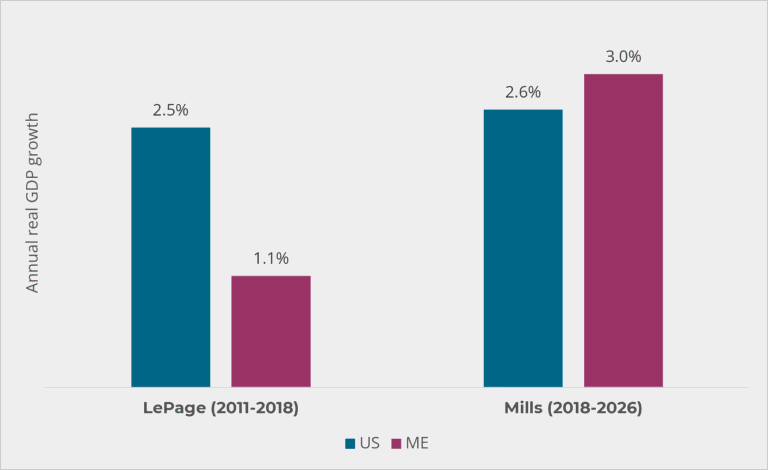
The results were stark. While US GDP grew by 13% during LePage’s tenure, Maine was one of only five states that failed to achieve positive net growth a full decade after the Recession began. It took Maine almost nine years to recover the jobs lost during the Great recession — among the worst performances in the nation.
LePage also opposed raising Maine’s minimum wage, even after voters approved an increase that ultimately benefited one in three Maine workers. He laid off more than 1,800 state workers and left hundreds of other positions unfilled.
At the same time, his administration left almost $2 billion in federal funding unclaimed or unspent between 2011 and 2017 — money that could have supported health care, food assistance, infrastructure, and other needs while also circulating through Maine’s economy.
Two eras, two economic trajectories
Source: MECEP analysis of US Bureau of Economic Analysis data
By contrast, the COVID-19 recession hit one year into Janet Mills’ first term. During her tenure, Maine’s economy rebounded stronger than the national average.
The difference matters: when families and businesses are struggling, government decisions can either help accelerate recovery or make the pain last longer.
Blocking health care voters had already approved
One of the clearest examples of LePage putting his own policy preferences ahead of voters was Medicaid expansion. LePage spent years fighting the expansion of healthcare, first in the legislature and even illegally defying a voter-approved referendum. That decision left tens of thousands of Mainers without health coverage and cost Maine approximately $500 million in federal funding every year, along with more than 4,000 potential jobs.
For older Mainers, the consequences were particularly significant. More than 16,000 Mainers age 50 to 64 who lost jobs or lacked employer-sponsored coverage were left without the health insurance Medicaid expansion would have provided.
LePage also reduced or revoked access to the Medicare Savings Plan for about 8,000 older and disabled Mainers. The program helps people with low incomes afford Medicare premiums and prescription drugs. He repeatedly attempted to eliminate it altogether, along with the Drugs for the Elderly program.
These were not abstract budget decisions. They affected whether Mainers could see a doctor, afford medication, or get health coverage after losing a job.
Cutting supports while poverty and hunger worsened
LePage governed during a period when many Mainers were still struggling to recover from the recession. His administration nevertheless cut access to programs designed to help families make ends meet. Tighter eligibility requirements for SNAP resulted in 42,600 Maine children losing food assistance, while Maine forfeited $142 million in federal food assistance.
LePage also restricted access to Temporary Assistance for Needy Families, a cash assistance program for low-income families with children. 16,000 Mainers lost assistance as a result. At the same time, his administration misspent and hoarded more than $155 million in federal TANF funds that could have supported families in need.
The consequences were especially severe for children. Maine children fell into deep poverty at eight times the national average. During part of LePage’s tenure, one in six Maine households was food insecure, and Maine ranked third in the nation for hunger.
LePage also failed to secure $3 million in available federal funding for child care assistance and even vetoed funding for Meals on Wheels.
Poverty fell after the LePage years
Source: MECEP analysis of US Census Bureau, Supplemental Poverty Rate data
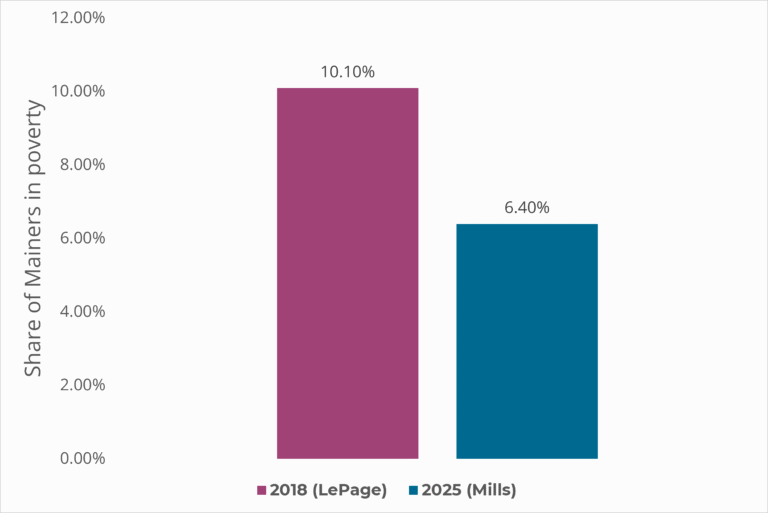
The point is not that poverty or hunger began with LePage. Maine had serious challenges when LePage began his tenure. But the policies adopted during those years made those challenges harder for many Mainers to overcome.
Shifting costs to towns and families
LePage’s tax policies reduced state income tax revenue by $895 million annually, with the benefits concentrated among wealthy households and corporations. The state then had fewer resources for schools, health care, and local services.
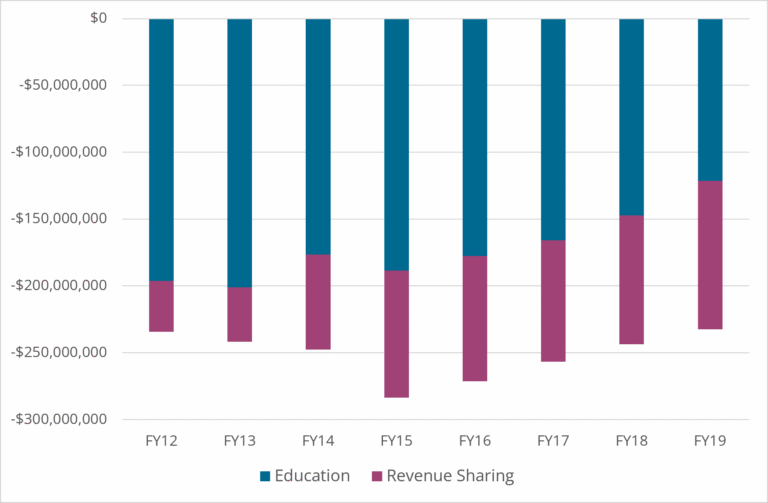
Even after LePage enacted extreme program cuts, laid off public sector workers, and expanded sales taxes to pay for the tax breaks, major shortfalls remained. In response, LePage shirked obligations and shifted costs to local communities. By refusing to fully fund public education and hoarding as much as 60% of the tax revenue the state should have been sharing with municipalities, towns were forced to raise property taxes to make up the missing money.
A funding gap: schools and communities left short
Source: MECEP analysis of state budget data
The pattern was consistent: tax cuts at the state level, followed by cuts to public services and more costs pushed onto families and communities.
Older Mainers left behind
Older Mainers faced a particularly long list of blocked investments and lost federal resources. LePage blocked $15 million in voter-approved funding for affordable senior housing, even though nearly 70% of Maine voters had approved the bond. The funding would have supported 200 energy-efficient homes for older Mainers with low incomes and weatherized another 100 homes. It also would have attracted more than $22 million in federal and other matching funds.
At the same time, LePage forfeited nearly $4 million in federal funding for Alzheimer’s and dementia programs and cancer prevention, cut prescription drug assistance, and blocked pay increases for direct care workers.
After trying to eliminate food stamps in Maine, he instituted an asset test for adults without children in the home. In 2018, 34% of Maine households receiving SNAP included someone age 60 or older. The change had a dramatic impact — cutting $12 million in funding and causing an estimated 8,600 older Mainers to lose food assistance simply for saving a small amount for unexpected emergencies.
Nearly $293 million in support left on the table

Altogether, LePage’s policies forfeited an estimated $255.7 million in federal funds intended for programs serving older Mainers, including health care, nutrition, cancer screening, Alzheimer’s and dementia support.
A record of choosing cuts over investment
Paul LePage inherited a Maine still recovering from a historic recession. His administration had choices about how to respond. It could have invested in recovery, protected access to health care and food assistance, fully funded schools and local governments, and used available federal resources to bring money into Maine.
Instead, LePage repeatedly blocked policies approved by Maine voters, cut services when families needed them most, shifted costs onto towns and households, and left billions in federal funding unclaimed or unspent. The result was a state economy that lagged behind the nation, a slower recovery from the Great Recession, and deeper hardship for many of the people who could least afford it.
For voters looking back at the LePage years, the record is not simply about individual budget decisions. It is about what happened when state government chose austerity over investment — and when federal dollars that could have helped Maine families, workers, seniors, and communities were left on the table.