

By Mark Shaffer | MECEP Action
October 8, 2026
The four things to know:
- Trump’s “One Big Beautiful Bill” cuts $2.7 billion from MaineCare, and 28,152 Mainers will lose coverage.
- Senator Collins promotes the Rural Health Transformation Program as the fix. Maine will receive just $950 million at most, $1.75 billion less than it loses.
- Of the $190 million Collins touts for this year, 96% of the money goes to out-of-state telehealth providers or administrative services like billing, records, and AI integration.
- Over the next decade, Maine faces a net loss of about $2.67 billion in health care funding.
28,000 Mainers lose coverage, and hospitals lose billions in funding for patient care
President Trump’s “One Big Beautiful Bill” (OBBB) cuts $2.7 billion over the next decade in Medicaid payments to Maine. The Trump administration promised the cuts would target fraud and people gaming the system. Instead, 28,152 Mainers will lose their MaineCare coverage. Rural hospitals that depend on Medicaid payments will lose billions and an already fragile rural health care system will be put at even greater risk all because Senator Collins didn’t block the bill when she had the chance to do so.
Senator Collins opened the door to cuts then offered a fix that falls short
In her own words, Senator Collins “allowed” the OBBB to go to the Senate floor. That made it possible for her to add the $50 billion Rural Health Transformation Program (RHTP) to the final bill to answer concerns about rural hospitals. She has called it the largest federal investment in rural health care while ignoring the root cause of the problem which is increased uncompensated care tied to millions of Americans losing coverage as a result of OBBB. Maine will receive only $950 million from RHTP over the program’s five years. That’s $1.75 billion less than the state loses in Medicaid cuts.
Nationally, the bill’s $1 trillion Medicaid cuts are the largest federal cuts to health care ever and dwarf the amount Collins helped secure for RHTP. The better solution would have been to protect funding for health care by blocking the bill from ever making it to the Senate floor in the first place.
Hospitals can’t use the money where it is most needed — providing care for patients
The RHTP program’s own rules limit how much can pay for patient care. Only 15% of the funds can go to paying providers for services. For Maine, that’s $142.5 million, which still leaves Maine $2,56 billion short after the Medicaid cuts.
But even that money didn’t survive. In June, Dr. Oz, who Collins voted to confirm, announced the Center for Medicare and Medicaid Services (CMS) rejected the parts of Maine’s plan that would have paid for care. The approved plan includes nothing to replace lost Medicaid payments.
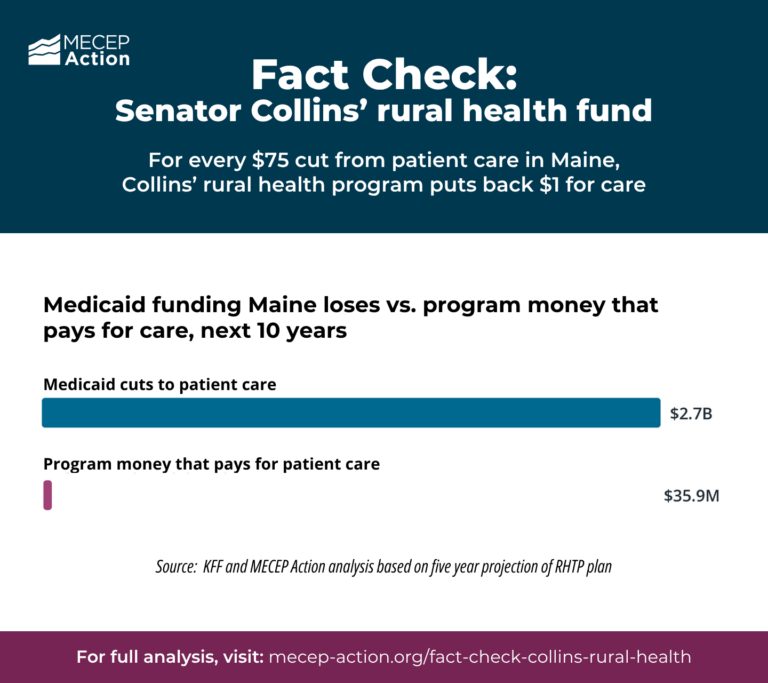
For every $75 cut from patient care, Collins’ rural health program puts back $1
Of the $190 million in RHTP funding, just $7.2 million pays for care from Maine providers — about $35.9 million over the program’s five years. In contrast, OBBB cuts $2.7 billion.
Follow the money: consultants, software, and AI before patients
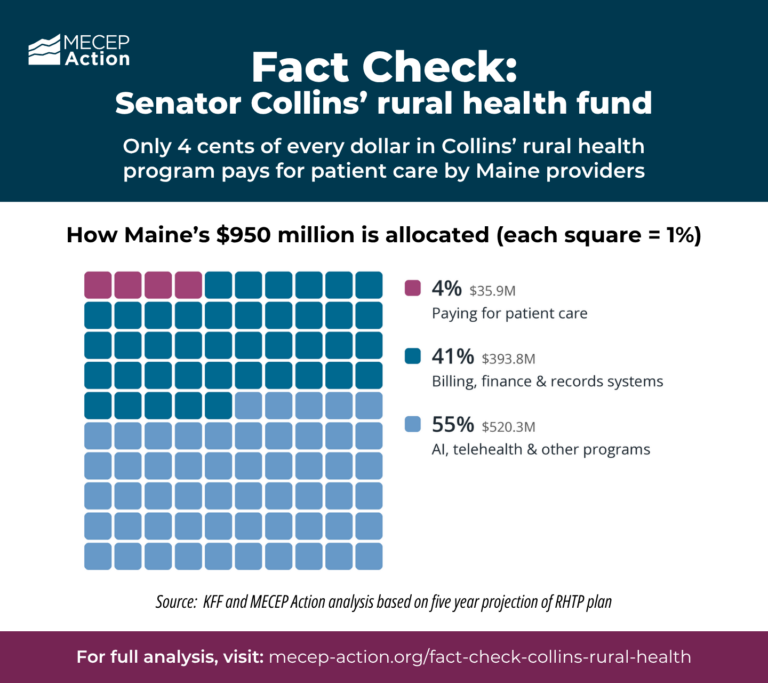
Of the $190 million Senator Collins claims to have secured for Maine hospitals this year, here’s what that money actually pays for:
- More than half goes to financial services firms, insurance benefit managers, administrators, universities, and out-of-state groups — not Maine providers.
- $33.8 million goes to a single nonprofit for AI adoption, telehealth hubs, and electronic records upgrades.
- $78.8 million reaches Maine providers, but about 80% of that pays for financial overhauls and new billing models.
- $7.2 million, about 4% of the total, pays for health care.
While these investments may have value, they don’t replace the revenue hospitals are losing.
What rural health care could look like
In the first year of funding, the program spends nearly as much building a new healthcare system ($72.2 million) as it gives to struggling Maine hospitals and providers ($78.8 million). Instead of keeping rural hospitals open, this program accepts they will close and offers something less in their place.
Instead of seeing your doctor, an EMT or community-health worker comes to your home to check your blood pressure.
Instead of a nurse or doctor helping you figure out what’s wrong, you talk to a staffer with no medical training who tells you where to go.
Instead of your local doctor, you get a video call with someone hundreds of miles away.
Instead of an ambulance to the hospital down the road, you wait for a helicopter to fly you across the state.
Billionaires get a tax cut. Rural Mainers get the bill.
Over the next decade, Maine will lose $2.7 billion in MaineCare funding and receive roughly $35 million for medical care through this program. That’s a net loss of about $2.67 billion. Susan Collins had the opportunity to stop this harmful bill in its tracks, but she chose not to. And now she claims credit for a program that doesn’t even come close to fixing the harm. Rural Mainers will pay the price so that billionaires and wealthy corporations can get tax cuts.