

By Mark Shaffer | MECEP Action
September 17, 2026
The four things to know:
- Earmarks aren’t the whole federal pie. The $1.06 billion attributed to Susan Collins is congressionally directed spending — not all the federal money coming to Maine. It’s one small slice of a much bigger federal funding pie.
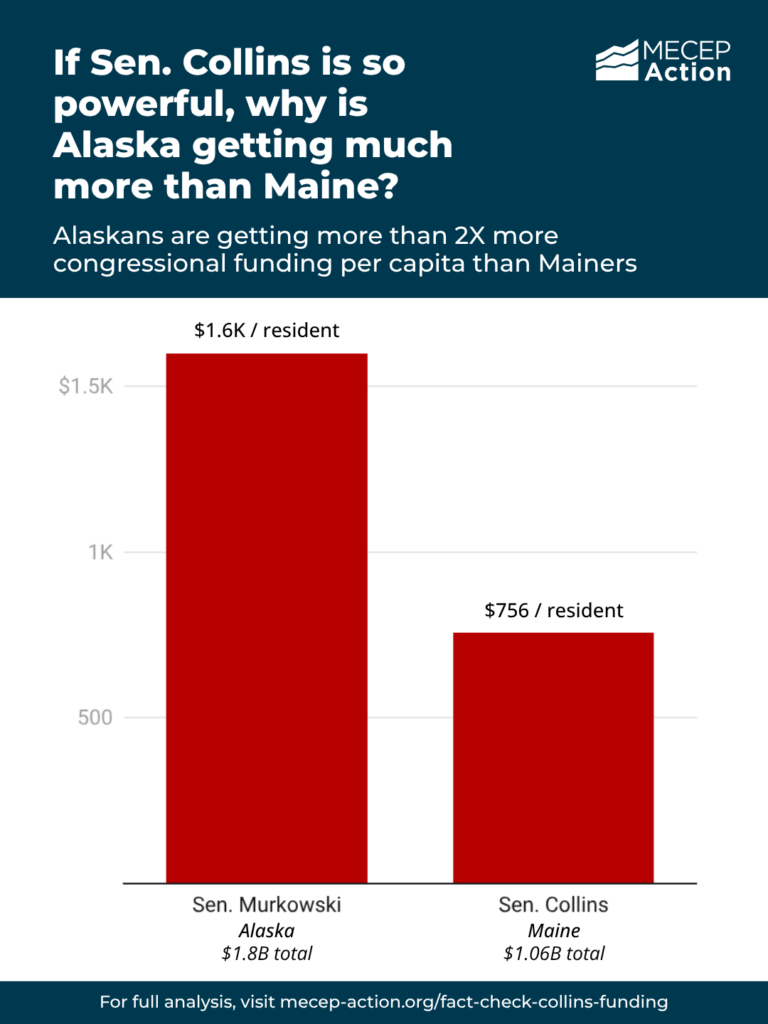
- $1.06 billion sounds big but it’s not exceptional. Collins secured about $1.06 billion in earmarks from 2022–2024, roughly $756 per Maine resident. Angus King secured about $832 million or $592 per resident. Alaska’s Lisa Murkowski secured about $1.18 billion equal to $1,599 per resident — more than Collins, and more than twice as much per person.
- Earmarks pick projects, not everyone. Earmarks go to specific projects and recipients and don’t measure the federal programs that reach people across Maine through Medicaid, SNAP, Social Security, Medicare, education, and more.
- “Bringing home the bacon” isn’t the same as making sure everyone gets a fair share. Saying “I brought this money home” doesn’t tell us whether broader federal policies are helping or hurting Maine communities.
Claim: Susan Collins brings home significantly more federal funding to Maine than other senators
Verdict: Misleading
The claim is based on congressionally directed spending — formerly known as earmarks — not on all federal funding coming to Maine. Under the current system, senators can request funding for specific projects and recipients in their states. The Government Accountability Office (GAO) tracks these projects and publishes the underlying data. For fiscal years 2022–2024, Congress directed approximately $39 billion to more than 20,000 projects nationwide.
An analysis of the GAO data finds Collins secured approximately $1.06 billion in such funding over the period, or roughly $756 per Maine resident. That’s a substantial amount of money, but it doesn’t establish that Collins is uniquely effective at bringing federal dollars home.
For comparison, Senator Angus King secured approximately $832 million, or about $592 per Maine resident. And Senator Lisa Murkowski of Alaska secured approximately $1.18 billion, about $1,599 per Alaskan resident — more total funding than Collins and more than twice as much on a per-capita basis. In other words, the available data doesn’t show that Collins’ position or influence produces an exceptional level of earmark funding compared with other senators.
There’s also an important caveat in comparing Maine’s two senators: some projects are jointly requested by Collins and King, so simply assigning the full value of those projects to each senator can make comparisons between them less meaningful. The GAO data identifies the requesting members, but the data doesn’t establish a jointly requested project happened because of one senator’s individual influence.
GAO’s figures concern a relatively narrow category of spending designated for particular projects — they do not measure the much larger universe of federal spending that flows to Maine through programs such as Medicaid, SNAP, Social Security, Medicare, education, infrastructure, veterans’ programs, or other formula-based or competitive grants. GAO itself describes the tracked funds as provisions designating money for particular recipients to use for specific projects.
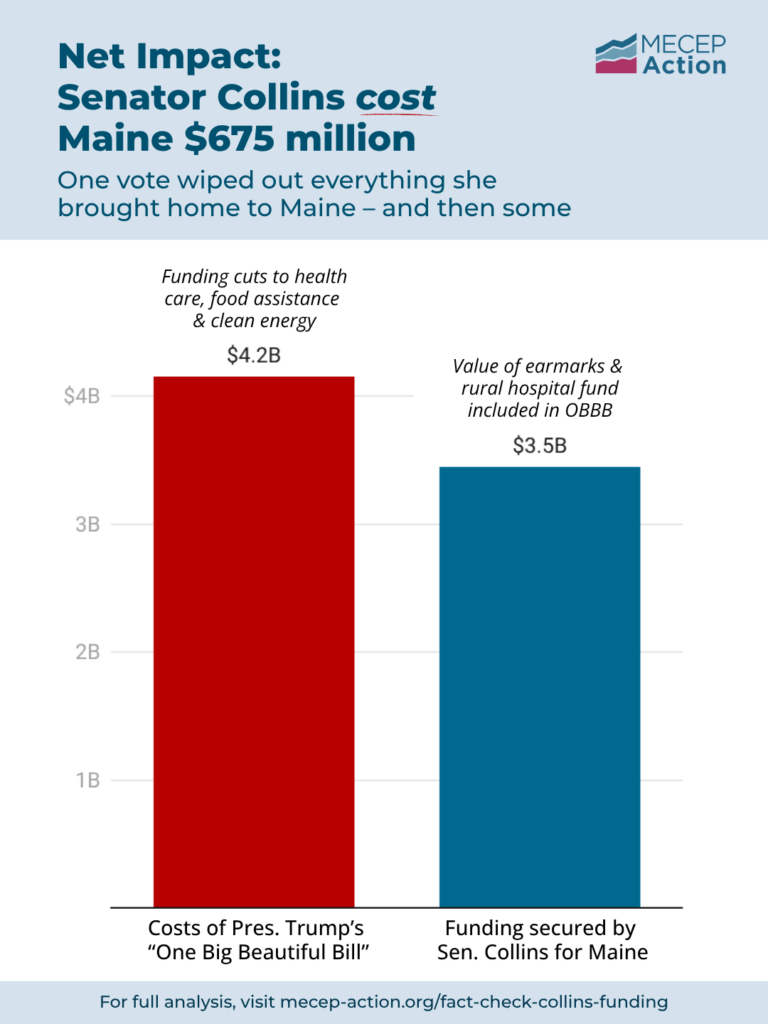
In a previous post, MECEP Action depicted the difference between what Senator Collins is bringing to Maine in the form of earmarks and through the Rural Health Transformation Program that she claims credit for compared to what Maine loses as a consequence of her vote to advance Trump’s “One Big Beautiful Bill” that cut funding for health care, nutrition assistance, and clean energy investments while delivering trillions in tax cuts to the wealthy and large corporations.
Earmarks are about who gets picked — not whether the system works for everyone
There is a more fundamental problem with treating earmarks as the measure of whether Maine is “winning” in Washington.
A senator can point to a new fire truck, wastewater project, community center, or hospital expansion and legitimately say they helped bring this money home. Those projects can be valuable and worth funding. But because earmarks are inherently targeted, some communities, institutions, and organizations receive funding while others do not. That creates a very different measure of government effectiveness than whether federal policy is providing broadly shared and sustainable resources.
Consider two Maine communities. One receives a federal grant for a new fire truck. The senator can stand beside the truck and say, “I brought this money home.” Meanwhile, the town next door is struggling to maintain its existing fire station as residents face higher costs and greater pressure on the public services they depend on.
One hospital receives a targeted federal grant. Another loses revenue because Medicaid funding is reduced.
One family receives help with a particular health care need. Thousands of other families lose coverage or face higher costs.
One community receives a targeted federal investment while communities across the state lose billions of dollars in health care, food assistance, or other federal resources.
The town with the new fire truck won. But that doesn’t necessarily mean Maine won.
Many of those projects should be funded. The issue is whether political success should be measured by a senator’s ability to pick individual winners and secure targeted benefits — or by whether the federal government is structured to provide reliable, broadly shared resources to the people and communities who depend on it.
Earmarks can create the appearance of a government that is responsive while leaving the underlying system unchanged. A government that works well for everyone shouldn’t require every community to have a politically connected champion to get what it needs.
The bottom line
Susan Collins has secured substantial congressionally directed spending for Maine. But the available GAO data does not substantiate the broader claim that she brings home dramatically more federal funding than other senators. Other senators have secured comparable or larger amounts, including when adjusted for population.
More importantly, earmarks represent only a small and highly targeted piece of federal spending. The ability to steer money toward selected projects is not the same thing as building a federal government that reliably invests in every Maine community.
That makes “bringing home the bacon” a particularly limited measure of representation. It tells us who got picked for a particular project. It doesn’t tell us whether the system is working for everyone. On that count, Senator Collins appears to be doing more harm than good.