

By Mark Shaffer | MECEP Action
October 22, 2026
In nearly 30 years in the Senate, Susan Collins helped pass legislation that gave $2.6 trillion in tax cuts to the top 1%. The results speak for themselves:
- The share of America’s wealth held by the top 1% has grown from 27% to 33% since Collins took office.
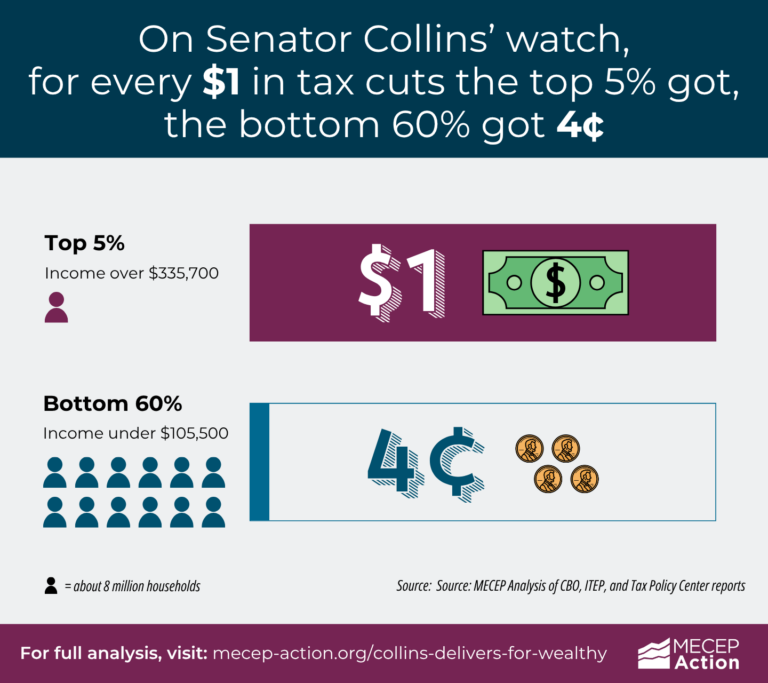
- The richest 5% have received 23 times more in tax cuts per person than the bottom 60%.
- A person earning $1 million a year gets roughly $50,000 in annual income tax savings.
- A millionaire investor gets another $50,000 in annual savings on capital gains.
- The heirs to a $1 billion estate save an estimated $156 million in estate taxes.
- Big corporations got a massive tax break. Tesla’s tax bill was reduced by hundreds of millions of dollars, with tax loopholes allowing the company to pay no federal corporate income tax last year.
The shift of wealth upwards was not a result of market forces, but policy choices. They are choices about who benefits from our tax system and who gets left holding the bag.
Tax cuts for the rich. A much smaller deal for everyone else.
For decades, Collins has backed the same basic promise: cut taxes for the wealthy and corporations, and the benefits will eventually trickle down to everyone else. But the results have gone in the opposite direction. Wealth has become more concentrated at the top, and working people have not shared proportionately in the gains.
Consider the contrast. Someone earning $1 million a year saves roughly $50,000 annually from cuts to income tax rates. A millionaire investor can save another $50,000 on capital gains. The tax changes that benefit billionaires and their heirs can spare a single $1 billion estate more than $150 million. Meanwhile, someone making under $105,500 gets about four cents for every dollar someone making over $335,700 gets.
These are enormous windfalls for people who already have substantial resources and do nothing to help families afford groceries, a heating bill, child care, or a mortgage. And the disparity is not an accident — it reflects deliberate policy choices Collins has repeatedly supported.
Since 1997, her votes have helped reduce taxes on high incomes, investment profits, corporate earnings, and inherited fortunes. The result has been a tax system that asks less of those with the greatest ability to pay, even as working Mainers struggle with rising costs and stagnant wages.
What the wealthy save, the rest of us are told we can’t afford
Here’s the part Collins and her allies would rather avoid: tax cuts have a cost, even when the bill doesn’t arrive in the mail.
Every dollar the federal government gives up in revenue is a dollar that cannot be used for other priorities or must be offset through other taxes, spending cuts, or additional borrowing. When lawmakers choose to give the biggest breaks to the wealthy, those choices shape what the country can afford to do for everyone else.
The Trump administration and congressional Republicans are now making that trade-off painfully clear. President Trump has said the United States cannot afford investments in child care, Medicaid, Medicare, and other essential programs because the country is fighting wars. War is expensive, and the costs of the Iran war alone have been estimated at $38 billion to $42 billion. But the tax breaks Republicans have enacted for the wealthy dwarf that figure: the “One Big Beautiful Bill” alone was projected to deliver $116.6 billion in tax cuts to the top 1% in a single year.
So when Trump says there isn’t enough money to help families, the question is where did the money go and who got it?
By a 23:1 margin, more of the money went to someone making over $335,700 than someone making under $105,500.
Tax cuts that disproportionately benefit the wealthy compound the problem by reducing public revenue at the same time families face rising costs and communities need resources for health care, education, housing, and other essentials. Collins should be using her power as Appropriations Chair to help working people, not repeatedly supporting tax cuts that send such outsized benefits to those at the top and enabling an administration whose choices make the squeeze worse.
Collins helped make these choices. She cannot wash her hands of the consequences.
Collins has supported major tax-cut legislation throughout her Senate career, including both rounds of Bush tax cuts and the 2017 Tax Cuts and Jobs Act. Unlike Senator Olympia Snowe who voted against the second Bush tax cut bill because of how it grew the debt. She also supported legislation that reduced taxes on investment gains and wealthy estates.
Her record on President Trump’s “One Big Beautiful Bill” is particularly revealing.
Collins ultimately voted against the bill’s final passage, but she voted to advance it on a key procedural vote that passed 51–49, helping clear the way for its enactment. Other Republican senators who opposed the final bill also opposed advancing it. Collins chose differently. A vote against final passage does not erase a vote that helped put the legislation on the path to becoming law.
The bill’s benefits and costs are not evenly distributed — the wealthy receive enormous tax advantages, while working families face the consequences of reduced public revenue and the administration’s decisions about what to fund and what to cut. Collins has had nearly three decades to demonstrate that her economic priorities deliver for ordinary Mainers. Yet the record shows a consistent pattern: tax cuts that disproportionately reward wealth, paired with arguments that the country cannot afford the investments working people need.
A different set of priorities is possible
The choice is between a government that prioritizes concentrated wealth and one that invests in the people and communities that make the economy work.
Revenue can support affordable child care, stronger public schools, accessible health care, housing stability, and the infrastructure Maine communities need. Those investments are not luxuries to be considered only after the wealthiest Americans have received another tax break. They are essential to a strong economy and a decent life.
Collins and Trump want Mainers to believe we can’t afford to do more for working families. But their own choices tell a different story. The government has found room for enormous tax breaks for millionaires, billionaires, and large corporations — while investments in working people keep taking a back seat to giveaways at the top.